Council policy and current practice

The policy promises protection. The program is removing canopy.

Banyule’s Urban Forest Strategy treats mature canopy as essential public infrastructure. Banyule City Council’s current street-tree clearance program appears to treat that same canopy principally as an obstacle within an extensive road-clearance envelope.

These positions require a public explanation.

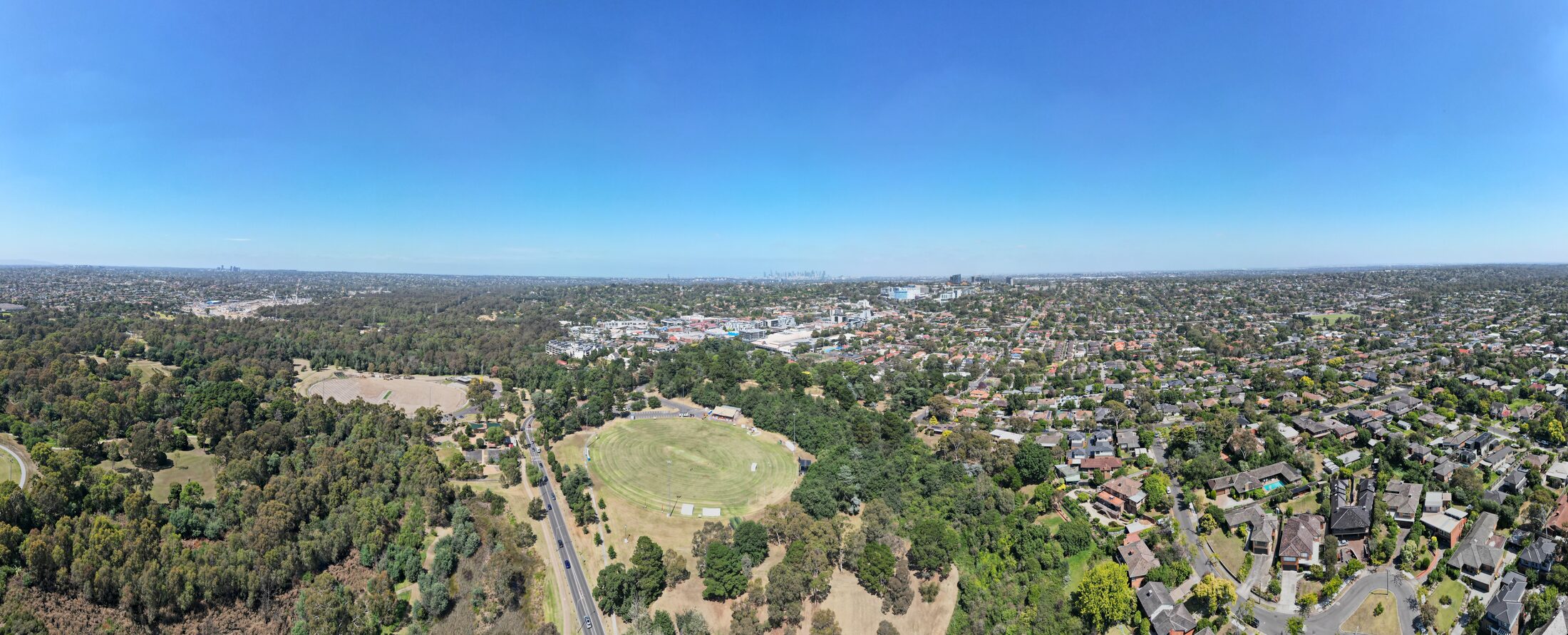
Aerial panorama of Heidelberg showing mature tree canopy across Banyule streets and parkland
Aerial panorama of Heidelberg facing the Melbourne skyline, February 2024, by Wanderingchina · CC BY 4.0 · Resized and optimised from the original.
45% local-road canopy target

Banyule’s Urban Forest Strategy seeks 45% canopy cover across the footpath and local-road network by 2050.

Approximately 270 trees

Council says around 270 street trees are currently being considered for works.

No published process

The affected trees, assessments, decision criteria, treatments and timetable have not been published.

What Council adopted

Banyule’s Urban Forest Strategy sets a clear direction.

  • Grow and protect canopy. Reach 30% canopy in every suburb and 45% across the footpath and local-road network by 2050, with no loss where targets are already exceeded.
  • Manage trees as essential assets. Recognise the urban forest as shared public infrastructure that supports health, climate resilience and the natural environment.
  • Use evidence-based practice. Make decisions that are responsible, fit for place and purpose, and informed by accurate data.
  • Make removal processes transparent. Develop documented methods for tree risk and clear processes for removal, reporting, enquiries, complaints and disputes.
  • Work with the community. Build genuine partnerships in which residents’ values and concerns are heard and decision-making is understood.
  • Apply the principles across Council. Integrate urban-forest outcomes into all Council initiatives, services, infrastructure and asset-management decisions.

Policy versus practice

Six points Council must reconcile.

Based on Council’s published Strategy and the information currently available about the street-tree program, the following inconsistencies require explanation.

Canopy protection

Banyule’s Urban Forest Strategy

Commits Council to expanding canopy across Banyule’s suburbs and local-road network and avoiding canopy loss in areas already above target.

The current program

Mature trees have already been removed or heavily pruned, including an approximately 70-year-old Red Flowering Gum that lost around two-thirds of its canopy. The campaign understands the remaining 150 “more complex trees” to be likely candidates for removal now that Council says the trees manageable through pruning have been identified.

Evidence and proportionality

Banyule’s Urban Forest Strategy

Commits Council to responsible, evidence-based management that is fit for place and purpose and considers canopy, climate, biodiversity, amenity and neighbourhood character.

The current program

Council has applied a 4.5 metre clearance across the full kerb-to-kerb width of local streets. It has not published the site-specific assessments or explained why this extensive interpretation is necessary.

Transparent decisions

Banyule’s Urban Forest Strategy

Calls for a documented Tree Risk Management Framework, clear removal procedures and transparent information for residents when trees must be removed.

The current program

Council has not published the affected locations, individual assessments, treatment decisions, criteria or timetable. Residents cannot see how canopy value and long-term tree risk are being weighed.

Community partnership

Banyule’s Urban Forest Strategy

Describes a healthy urban forest as the result of strong partnership between Council and community, with concerns heard and decisions understood.

The current program

Removal and major pruning began before residents were given tree-by-tree information or a meaningful opportunity to respond. The works were paused only after community campaigning and resulting media coverage.

Long-term asset management

Banyule’s Urban Forest Strategy

Treats trees as long-lived public assets whose amenity, ecological, cooling and neighbourhood value should be recognised in Council decision-making.

The current program

The Road Management Plan’s clearance requirement appears to have been given priority without showing how those wider public values were assessed. Reported engineering solutions for around 50 trees show that less destructive responses are possible.

Whole-of-Council integration

Banyule’s Urban Forest Strategy

Requires urban-forest principles and outcomes to be incorporated across Council services, projects, infrastructure programs and other strategies.

The current program

Council has not explained how implementation of its Road Management Plan has been reconciled with Banyule’s Urban Forest Strategy. One adopted plan should not be implemented as though the other does not exist.

Questions for Council

What must be explained before works resume.

Council can reconcile its policies only by publishing the evidence and showing how Banyule’s Urban Forest Strategy has shaped every decision.

  1. How does removing or severely pruning established mature canopy advance the local-road canopy target in Banyule’s Urban Forest Strategy?
  2. What technical and legal basis supports measuring the “trafficable portion” from kerb to kerb, including parking lanes?
  3. What assessment was made of each tree’s health, structure, amenity, ecological value and remaining useful life?
  4. Which engineering, traffic-management and risk-reduction alternatives were considered for every affected tree?
  5. How were residents informed and given a meaningful opportunity to respond before work began?
  6. How has the Road Management Plan been integrated with Banyule’s Urban Forest Strategy rather than applied in isolation?

Council’s own documents

The commitments are already published.

The comparison above draws on Banyule City Council’s adopted urban-forest documents and its current Road Management Plan:

Note: This page identifies an apparent inconsistency between Council’s adopted policy commitments and the reported implementation of its street-tree clearance program. It does not assert that Council has committed a legal breach. Council should publish the information needed for residents to assess whether the two approaches can be reconciled.

Take action

Ask Council to make practice match policy.

Before works resume, Council should show how every proposed intervention complies with both its road responsibilities and Banyule’s Urban Forest Strategy.

Ask Council to publish:

  • the affected trees and proposed treatments;
  • the individual assessments and decision criteria;
  • the alternatives considered; and
  • the policy analysis reconciling both plans.